Local government intelligence · Sourced and shipped

The county and local government
intelligence tool, sourced from the public record.

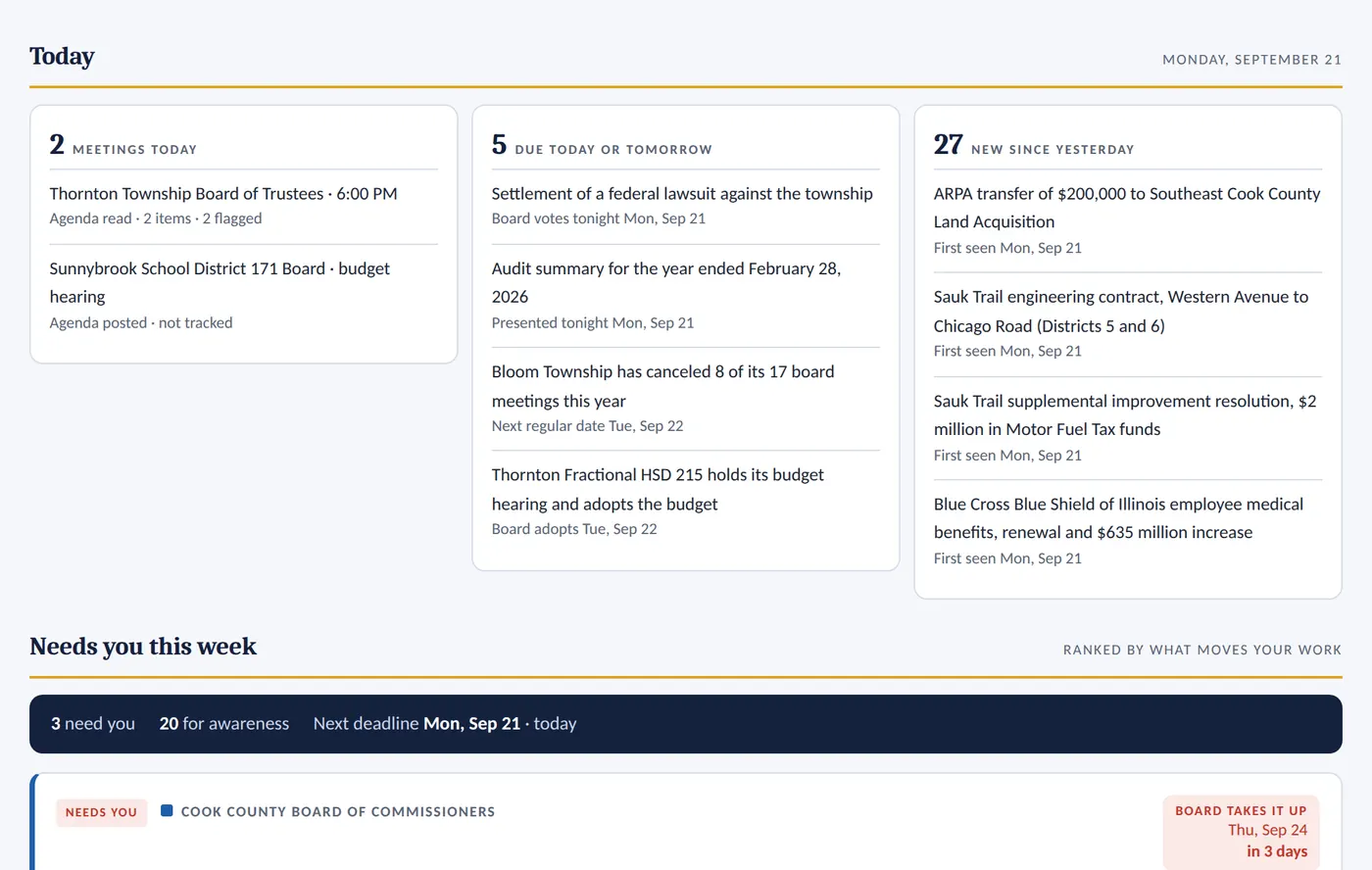
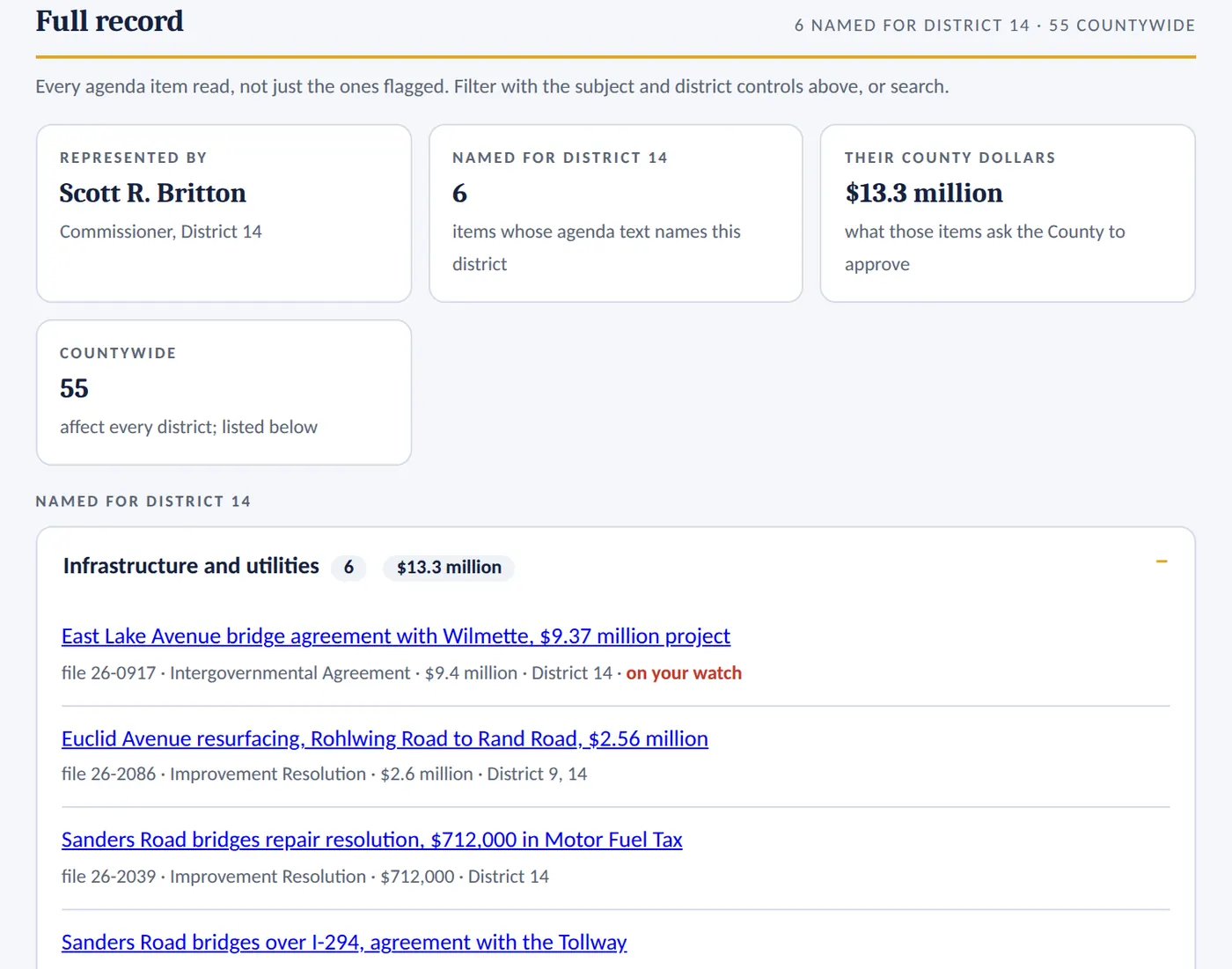
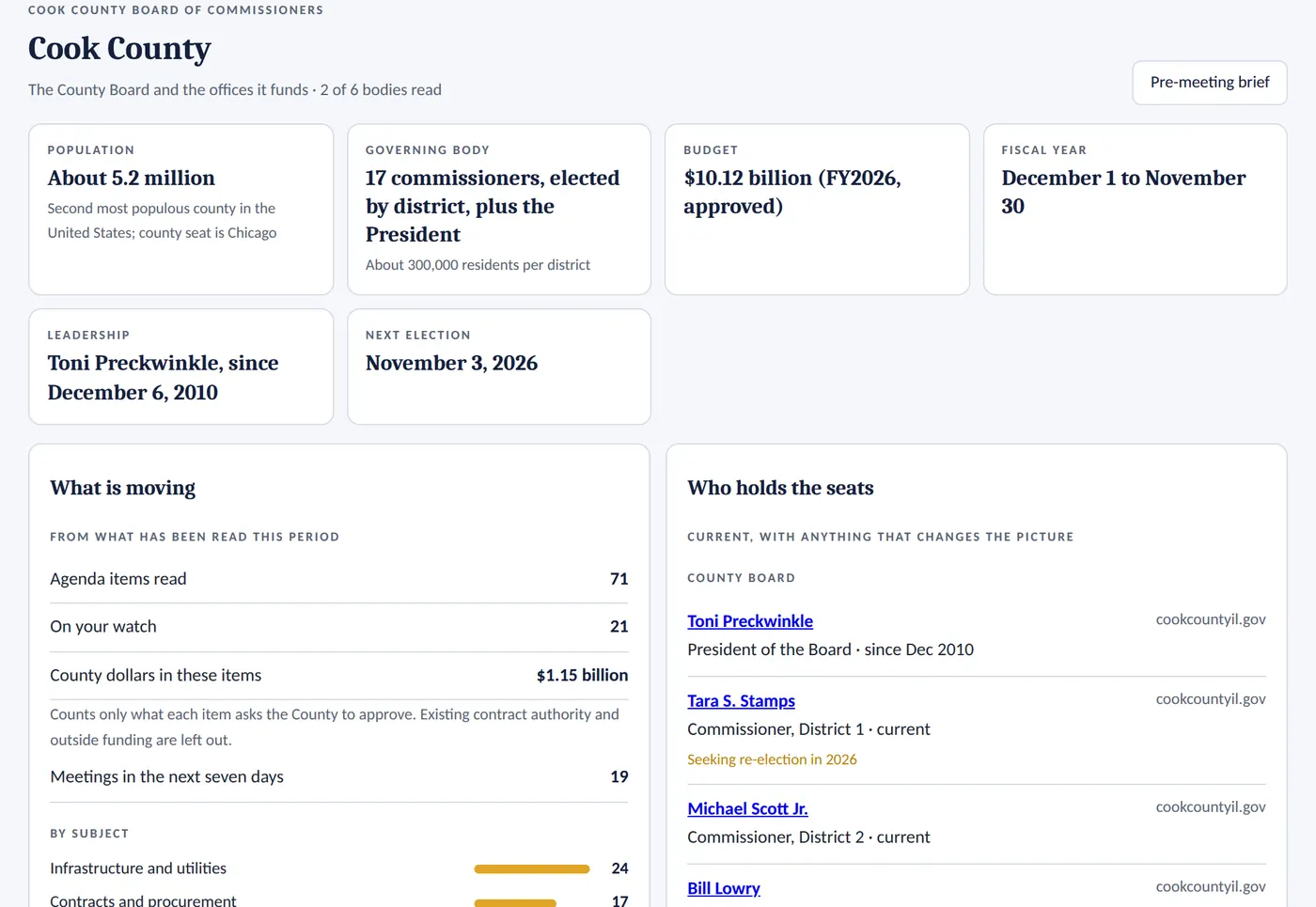
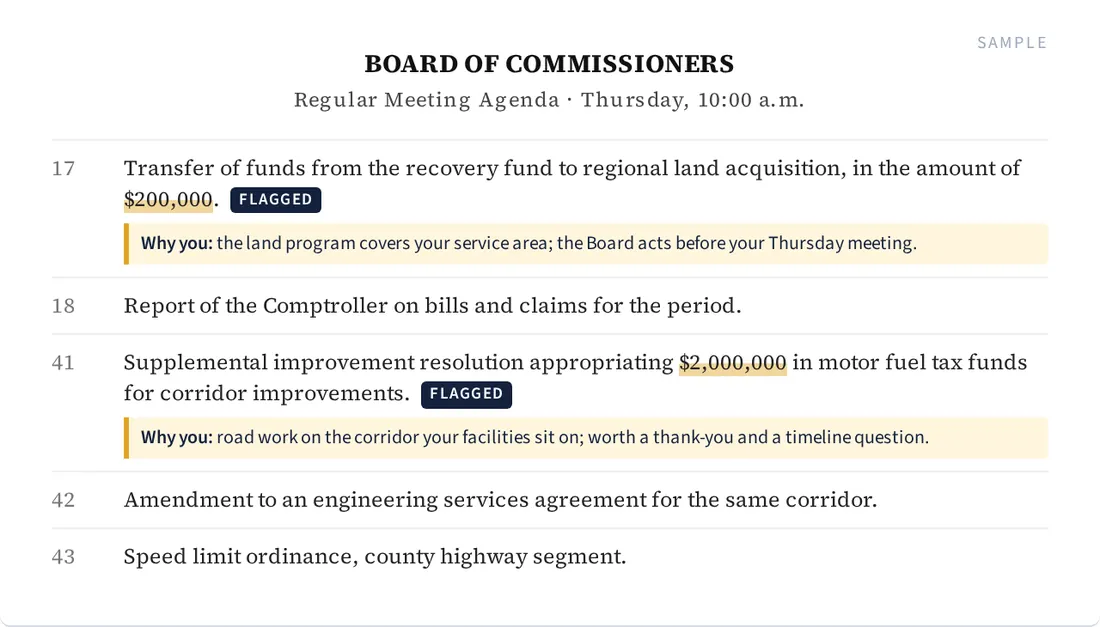
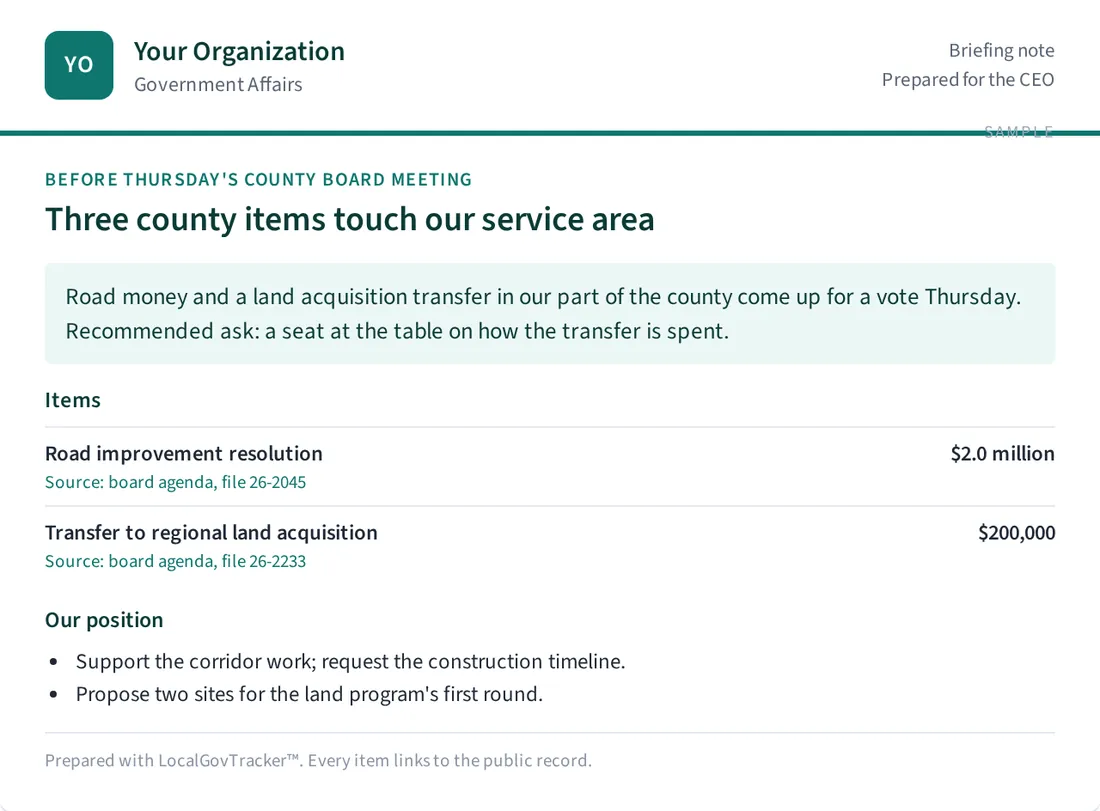
You name the councils, county boards, school boards, and special districts. Before each meeting you get a written brief: what is on the agenda, who decides, how they have voted, and what it means for you. Every fact links to the document it came from.

A body that met and did nothing should never look like a record no one reached.

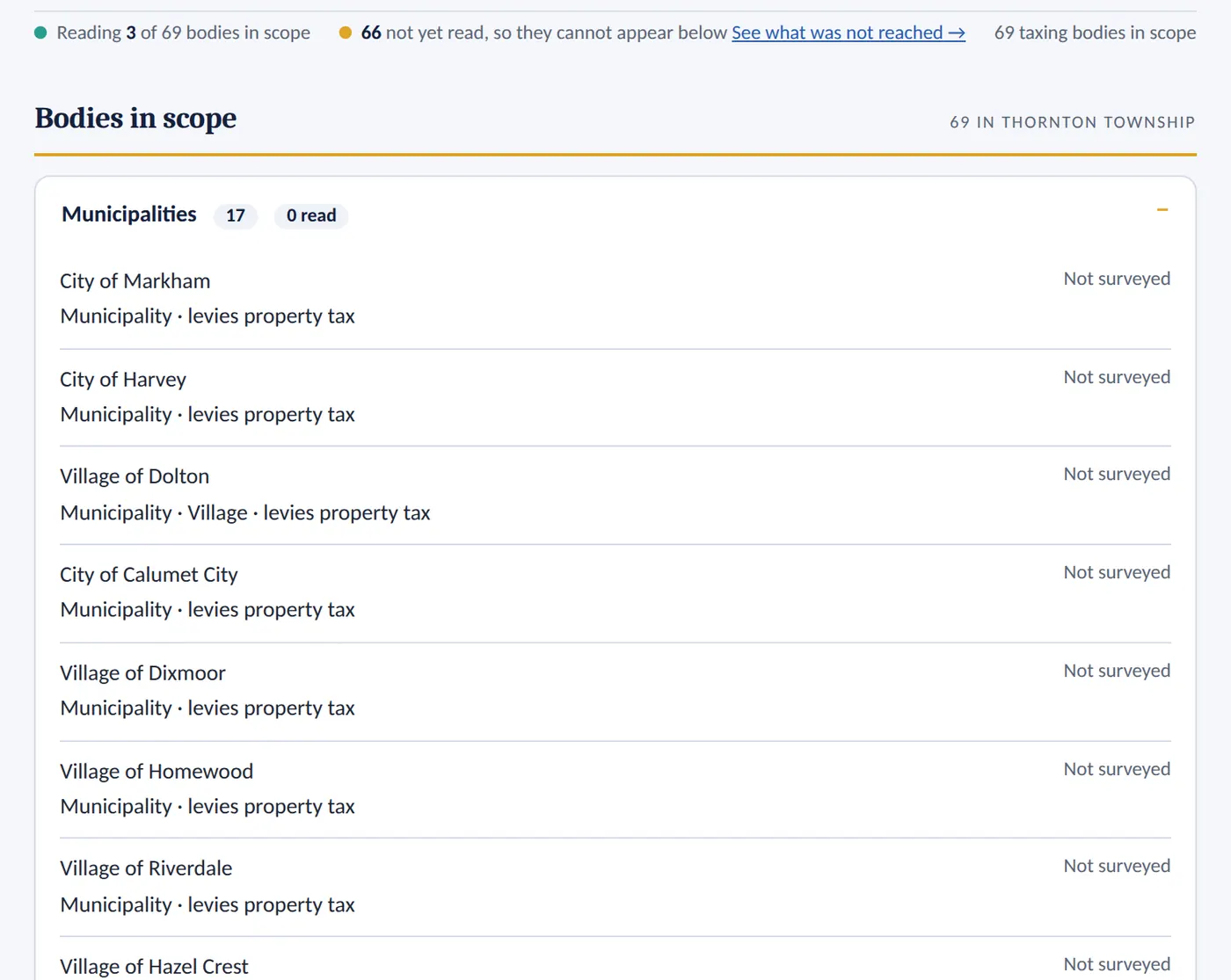
That is the blind spot every tool in this category shares. When a search comes back empty, nobody can tell you which one happened, and those are opposite facts. We survey how each body publishes before we take it on. Nothing is held back for being incomplete. Every item ships with its status attached: verified, no record found, or not reached. You get the work and you get to see exactly how far the record goes.

Live and validated in Cuyahoga County today, and built to read any jurisdiction in any state. Cleveland is the proof point, not the boundary. A new geography is a build, not a wall.

Request a Demo → See a sample brief
Every fact
linked to its source document
Every gap
printed, never filled in
Any state
your bodies, surveyed before we quote
Agenda Intelligence· Board Member Profiles· Named Votes· Community Dossiers· Brief Generator· Crisis Counsel· Pros & Cons Analysis· Communication Strategy· White-Label Ready· Word Download· Agenda Intelligence· Board Member Profiles· Named Votes· Community Dossiers· Brief Generator· Crisis Counsel· Pros & Cons Analysis· Communication Strategy· White-Label Ready· Word Download·

Stay informed

Local government moves fast. One email when something matters. No pitch.

Who it’s for

Hover any one of these to see what changes for you. Tap to see the brief. LocalGovTracker reads your own bodies and the ones around you. It is not a surveillance tool. We track public information.

Our founding philosophy
“Government is not built from the top down.
It begins locally.”

Every major policy you care about started as an ordinance in a city council chamber. Every state law that shapes your organization was voted on by local officials before it ever reached your state's capital. The people who win at the local level, whether for clients, a mission, or a community, are the ones who see it coming before anyone else does.

LocalGovTracker is built on this principle Bottom Up. Always.
The advantage

Be the most informed
person in the room.

The edge at the local level goes to whoever sees it coming first: the seated official's voting pattern, the budget line about to move, the agenda item that touches you, before the meeting, not after. LocalGovTracker gives you that, sourced and verifiable, on any jurisdiction you track.

Without LocalGovTracker
Teams spend 6-10 hours per week reviewing municipal websites for agenda updates
Board member intelligence lives in people’s heads - and walks out when they leave
Brief drafting takes 3-5 hours per document - rushed and inconsistent
Expanding to a new jurisdiction means starting research from zero
No structured pros/cons analysis - readers get conclusions without reasoning
Capacity is capped by staff hours, not by how much you need to watch
With LocalGovTracker
Agendas and meeting schedules pulled for your tracked jurisdictions, on request
Board profiles from the public record - committees, sponsorship, priorities, named votes - sourced, with gaps flagged
Brief research and drafting cut from hours to minutes - you review and refine
Any community profiled in minutes from public sources
Pros, cons, and a strategic verdict built into every brief
You cover more ground without adding staff

Brief research and drafting drop from hours to minutes, so the same team covers more ground. The speed is the payoff. The intelligence is the point.

The tool

Five modules. One workflow.
Built around how the work gets done.

Every module connects to the next. An agenda item becomes a brief becomes a finished deliverable - in minutes, not hours.

What this is, and what it is not

LocalGovTracker is not a chatbot pointed at local government. A general model asked about your county will answer from whatever it absorbed in training, sound confident, and have no way to tell you what it could not see. That is the failure that costs people their credibility in a room.

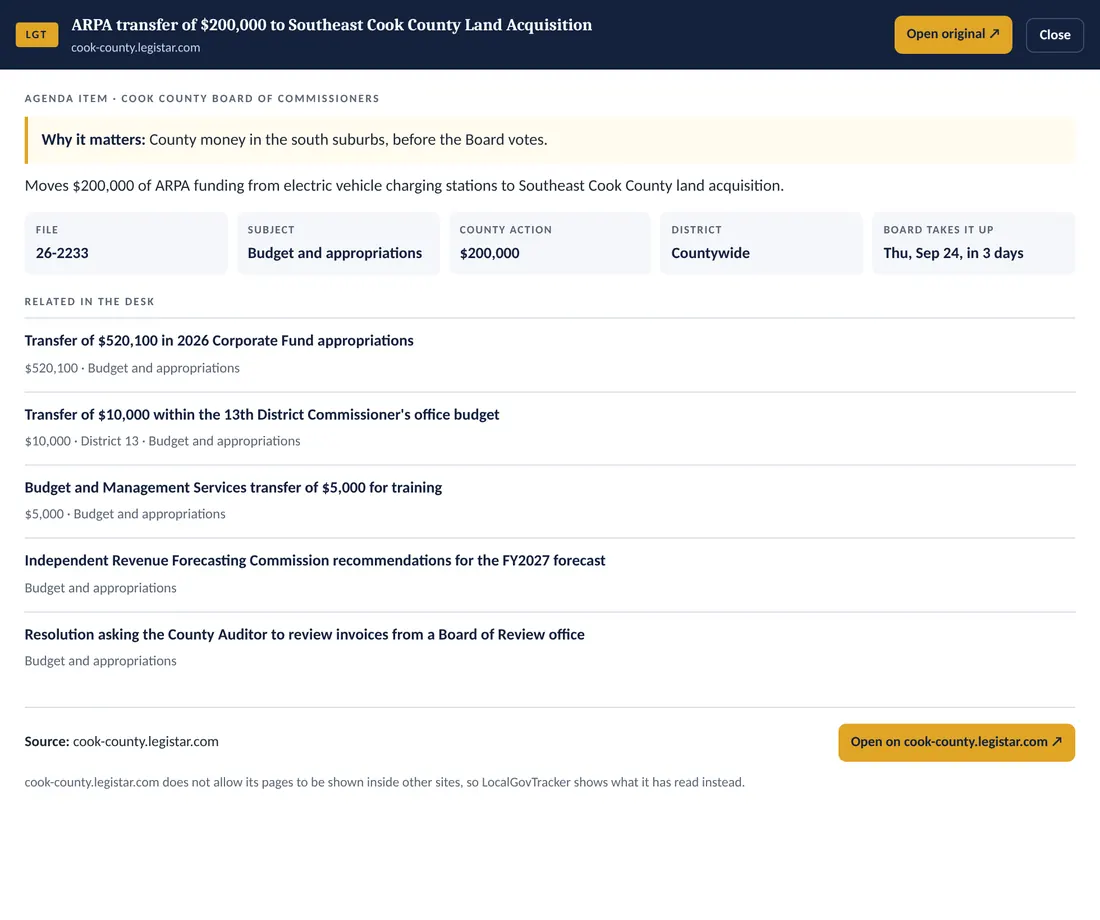
What we built instead is connected to the actual record. Retrieval is engineered per body and confirmed before we take that body on. Every fact carries the document it came from and the date it was last checked. What the record does not show is printed as a gap rather than filled in. And a person stands behind the work, because judgment about what matters to your organization is not something you should be outsourcing to a model.

Nothing is modeled, estimated, or inferred. Where a person or an item has no entry, the record says so rather than leaving a blank, because an empty field and an unresearched field are different things. Where we assess impact rather than report it, that is labeled as an assessment.

Think of it less as software you operate and more as a colleague who reads everything you cannot get to, hands you the sourced version before the meeting, and tells you plainly when the record is silent. It does not replace the person who knows your organization. It gives that person their week back.

How it works

From agenda item
to client brief,
in a fraction of the time.

The tool is designed around your actual workflow. Not how a tech team imagined the work - how it actually works, built by someone who has been in the room.

01
Tell us your jurisdictions
We set up coverage for the municipalities, boards, and commissions that matter to you or your clients, and surface the agenda items worth watching.
02
We research the board and the issue
From the public record we build profiles of who's in the room - committee roles, sponsorship patterns, stated priorities, disclosed conflicts, and named votes where the minutes record them. What the record doesn't show, we flag.
Sourced, not guessed
03
We draft the brief
A full pre-meeting brief with pros and cons at every decision point and a one-sentence strategic verdict. You review, refine, and add what only you know. What took 3 to 5 hours now takes minutes.
Pros & cons built in
04
You put it to work
A formatted, ready-to-send Word brief on your letterhead, in a fraction of the manual time. The self-serve, one-click version of this workflow is in development.
Brief generator

Four brief types. Pros and cons
built into every section.

The brief engine doesn’t append pros and cons at the end as an afterthought. They’re woven through every decision point - with a one-sentence strategic verdict that says exactly what to do.

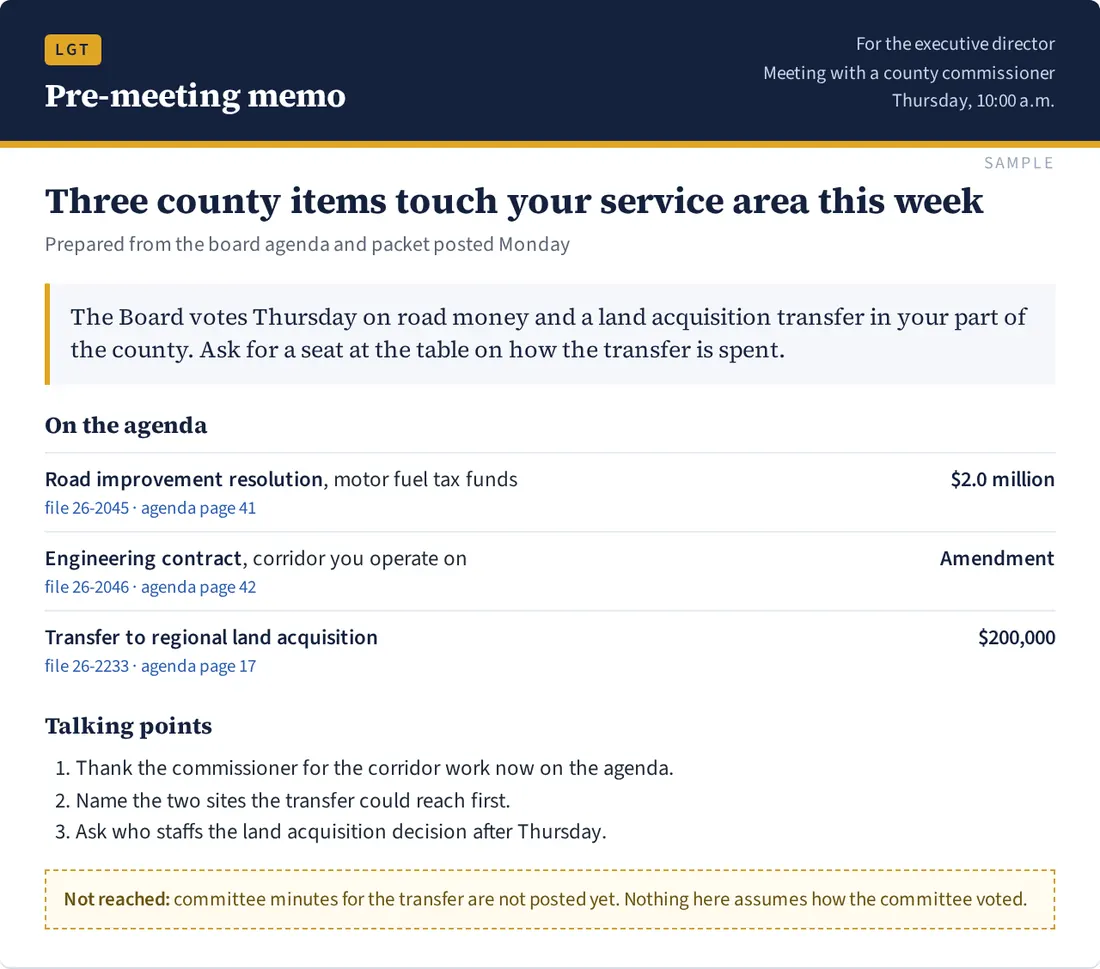
Pre-Meeting Brief
Agenda analysis, board intelligence, talking points, anticipated pushback, and an action plan before and after the meeting.
Pros/cons on your position
Board member vote tendencies
5 numbered talking points
Policy Brief
Issue background, stakeholder analysis, policy options each with pros/cons, recommended position, and anticipated opposition.
Each option: pros/cons/verdict
Stakeholder mapping
Opposition responses
Legislative Brief
Bill summary, legislative status, key provisions, impact assessment, pros/cons of supporting vs. opposing, and an action plan.
Support vs. oppose analysis
Amendment watch
Decision-makers to engage
Funding Brief
Grant opportunity, eligibility, evaluation criteria, pros/cons of applying and partnership strategies, and a competitive positioning assessment.
Solo vs. partnership analysis
Competitive positioning
Application timeline
See a finished one

Every brief generated through LocalGovTracker - for any jurisdiction, any state - follows the same two-part structure: an executive memo the reader takes in 90 seconds, followed by a full intelligence brief with board profiles, pros and cons analysis, and a strategic verdict. Download any sample below or request one built for your own jurisdiction.

All sample briefs are prepared using publicly available information and are clearly marked for demonstration purposes only. They reflect the format, structure, and analytical depth of briefs generated through the LocalGovTracker service. No confidential information is included.
Pre-Meeting Brief · Introduction
Health system CEO meets municipal mayor
A regional health system CEO's introductory meeting with a municipal mayor. Focus: housing, community health, and partnership alignment. Includes executive memo, full mayor profile, meeting flow, and five talking points.
Housing Health City Government Introduction
Pre-Meeting Brief · Policy
Nonprofit advocates before County Commission
An affordable housing nonprofit preparing for a county commission hearing on a housing trust fund. Includes board profiles, named votes, pros and cons analysis, and recommended position with strategic verdict.
Affordable Housing County Commission Nonprofit Policy
Pre-Meeting Brief · Funding
GR firm presenting federal funding strategy
A GR firm preparing a client for a village council meeting to advocate for federal fund allocation toward broadband infrastructure. Includes agenda analysis, council profiles, funding brief with eligibility and competitive positioning.
Federal Funding Broadband Village Council Funding
Pre-Meeting Brief · Legislative
Developer navigating planning commission hearing
A real estate developer's GR firm preparing for a planning commission variance hearing. Includes board member profiles, opposition mapping, legislative brief on the zoning request, talking points, and responses to anticipated pushback.
Zoning Planning Commission Development Legislative
Want to see your own jurisdiction?

Request a brief built for your actual client

Tell us the meeting, the official, and the jurisdiction. We will generate a sample brief using real board intelligence from your market so you can see exactly what you would receive. No commitment required.

Advisory services

Crisis Management &
Communication Strategy

When the political environment shifts faster than your organization can respond - you need someone who understands both the government relations landscape and how organizations communicate through institutional pressure. Built from the bottom up.

We lead with discretion. A first conversation is confidential, carries no obligation, and does not require you to put anything in writing that you would rather not. Nothing is documented, shared, or acted on without your direction.

Urgent inquiries

Reach the Crisis Counsel team directly.

Reputations are built over years and tested in days. When a situation is developing, the most useful next step is usually a direct conversation with someone who has handled one before.

We ask for three things. Everything else can wait for the conversation. Someone from the Crisis Counsel team responds within 24 hours, and usually the same business day. Nothing is documented, shared, or acted on without your direction.

✓ Received. Someone from the Crisis Counsel team will reach out within 24 hours, and sooner if you marked it more urgent.

Prefer email? Write to info@localgovtracker.com and it reaches the same people.

What we do
Crisis Preparedness Planning
Before a crisis hits - stand-up response plans, pre-drafted holding statements, decision trees, and stakeholder communication protocols tailored to your specific political environment.
Active Crisis Response
When something breaks - rapid strategic counsel on messaging, stakeholder sequencing, elected official engagement, and media positioning grounded in current local government intelligence.
Elected Official & Government Relations
Managing the government relationship during a crisis is as important as managing the public one. We handle the council members, county commissioners, and agency officials who hold your organization’s future.
Internal Communication Strategy
Governing boards, executive teams, and staff need a clear, consistent internal narrative - especially when the external environment is volatile. We align your organization from the inside out.
Post-Crisis Recovery
Rebuilding trust with elected officials, community partners, and the public after an incident. Strategic engagement plans, relationship repair, and narrative repositioning.
Why WGR for crisis

Most crisis communication firms think top-down - they draft press releases and manage national media. But the crises that actually threaten local organizations begin at the municipal level.

A bad council vote. A county commissioner who goes on record against you. A grant denial that goes public. A board dispute that spills into a city meeting. Those require someone who understands local government from the inside.

WGR's founder managed crisis communication across 57+ Ohio municipalities at a major regional health system - on both sides of the crisis: as the elected official receiving the call, and as the executive making it.

Common crisis scenarios
Funding loss or grant denial Adverse council vote Regulatory action Board governance dispute Public health incident Budget cut advocacy Leadership transition Media scrutiny Intergovernmental conflict Community opposition Ballot measure defeat Agency investigation
LocalGovTracker advantage
Subscribers get a built-in early warning advantage - the agenda tracker flags items that represent reputational or regulatory risk to your organization before the meeting, not after. Crisis prevention is always cheaper than crisis response.
Crisis service options
Retainer Add-On
Structured to scope
Per month - added to advisory retainer
Standing crisis preparedness plan. Pre-drafted holding statements for your most likely scenarios. A WGR advisor on call within 2 hours if something breaks. Monthly political risk landscape review. The cost of not having a plan when a crisis hits is always higher than the retainer.
Strategic Counsel
Structured to scope
Long-form organizational engagements
Extended crisis recovery, narrative repositioning, board governance support, and post-crisis relationship repair with elected officials and community partners. Scope and terms defined after a discovery conversation with a WGR advisor.

Crisis doesn’t wait for a scheduled call. Neither do we.

Speak With Someone Now → Request a Demo

Opens a message to info@localgovtracker.com. Handled in confidence, replied to the same business day.

Understanding the tool

What are you
actually paying for?

Coverage is scoped to the bodies you name, in any state. Two things set the price: how many bodies you track, and how many separate systems each one publishes through. Most bodies publish through one. Some publish through several, and the ones that award contracts are often the ones that sit outside the main system.

What you name
One jurisdiction = one governing body with its own meeting schedule and agenda.
Any unit of local government that holds regular public meetings, makes policy decisions, and has an elected or appointed governing board counts as one.
What we have to read
A body’s record does not always live in one place.
A council may post agendas in one system, minutes in another, and its contract awards through a department site that shares no identifier with either. Each system we read for you is a separate build, and each one is priced. This is why we survey a body before we quote it. Two bodies that look identical on paper can differ several times over in what it takes to read them.
Counting works two ways
A single city or county can contain several bodies. For example:

City Council = 1 body
Planning Commission = 1 body
County Commission = 1 body

Tracking all three means tracking three bodies. Separately, one of those three may publish through more systems than the other two combined. We tell you which before you commit, not after.
What qualifies as a body
Municipal Governments
Cities and villages in any state - 19,502 municipalities nationwide
County Governments
County commissioners and county councils - 3,031 organized county governments nationwide
Township Governments
Board of trustees - 16,214 township governments nationwide
School Districts
Boards of education - city, local, exempted village, joint vocational, and independent school districts
Library Districts
Public library boards of trustees - county, municipal, and special library districts nationwide
Fire Districts
Fire and EMS district boards - joint fire districts and fire departments with independent governance
Park Districts
Park district boards of commissioners - metropolitan, county, and township park districts
Special Districts and Authorities
Port authorities, transit authorities, water and sewer districts, soil and water conservation districts, regional planning commissions, and metropolitan planning organizations
Health and Human Services Boards
Behavioral health boards, developmental disabilities boards, job and family services, and local boards of health
Other Governing Bodies
Planning commissions, zoning boards of appeals, civil service commissions, housing authorities, airport authorities, and convention facility authorities
What every tracked jurisdiction includes
Agenda tracking
Agendas and meeting schedule, with the items that affect you flagged.
Board & member profiles
Seated officials from the public record - committees, sponsorship, priorities, named votes.
Community dossier
A sourced profile of the jurisdiction - structure, officials, cadence, overlapping bodies, context.
Municipal code
The jurisdiction's codified ordinances, on hand for reference alongside the intelligence.
?
Not sure how many jurisdictions you need?
During your onboarding call we will map your current client portfolio against the jurisdiction definition and help you select the right tier. No guesswork required.
Services

Structured to scope,
not squeezed into a tier.

LocalGovTracker is scoped two ways: the bodies you need watched, and how many separate systems each of those bodies publishes through. Tell us what matters to you and we map coverage and a fit, whether you are a firm, a company, a nonprofit, a health system, a district, or an office. Advisory is a scoped add-on, never the lead.

What is included
Agenda and meeting tracking
Agendas, packets, and meeting schedules for each body you name, with the items that touch you flagged by category and likely impact.
Board and member profiles
Seated officials from the public record: committee roles, sponsorship, stated priorities, disclosed conflicts, and named votes where the minutes record them.
Community dossiers
A sourced profile of each jurisdiction you track. Structure, the bodies that actually act, meeting cadence, overlapping jurisdictions, and links out to the municipal code.
Brief generator
Tell it who the brief is for and who you are meeting, and it composes the document. Brief gives a page one memo for the reader who has ninety seconds. Dossier gives the full chronology, positions of record, and citations. Delivered as a formatted Word document on your letterhead.
Issue files
A standing file per issue rather than a stream of alerts. Every action, actor, and figure on the public record held in one place and updated as the file moves, ordered by exposure rather than by date.
Actor continuity
The same person surfacing on two unrelated files is the thing a clipping service will never show you. We trace who appears where, across issues that look like they have nothing to do with each other.
Cross-body item tracing
The same item followed as it moves between bodies, so a measure that starts in committee and lands somewhere else does not read as two unrelated events.
Contracting-body discovery
We identify which bodies actually award contracts in your area, including the ones publishing outside the main legislative system, before we scope anything.
Printed gap notices
Where we could not reach a body or a document, the brief says so on its face. A body that met and did nothing never looks the same as a surface we failed to read.
Community engagement strategy
For organizations that need to be known before they need something. Which bodies to appear before, when public comment actually matters, who the standing community voices are, and how to build a record of presence rather than showing up only when an item threatens you.
A recommended next step
Each file closes with the objective, who to align with, the date it has to happen by, and what to handle with care. Not a summary of what happened. A position on what to do about it.
Advisor access
A person who knows your bodies, reads the record with you, and answers the question behind the question. Included, not billed separately.
Intelligence library
A searchable archive of your briefs and dossiers by client, jurisdiction, and date. Rolling out with the self-serve version; until then we retain and re-send on request.
White-label
Briefs and dossiers carry your brand, not ours. A branded portal now, your own domain as the self-serve version rolls out.
How we engage

Three shapes, scoped to what you actually need. Nobody is moved up a tier to get something they already needed.

Tracking
LocalGovTracker™
The bodies you name are read on their own schedule. Briefs, dossiers, and profiles on request, every fact sourced and every gap printed. This is the product, and it never leaves.
Tracking with interpretation
LGT plus advisor read
Everything above, plus a person telling you what a given item means for your organization or your client, what is likely to happen next, and what is worth doing about it.
Advisory and community engagement
Winston Government Relations, scoped add-on
Strategy, positioning, community engagement, and Crisis Counsel when the situation calls for judgment rather than coverage. Scoped separately and never the lead. Tracking always stays with LGT.
What it changes
Coverage you cannot staff
No single person can sit through a dozen bodies meeting on separate calendars, and hiring for it is rarely justifiable. This is the part that gets skipped quietly until something surfaces late.
Sourcing that survives a challenge
Every claim carries its document and the date it was last checked. When someone in the room asks how you know, the answer is a link rather than a recollection.
Judgment, not just documents
A pile of matched keywords is not intelligence. What you receive is read, weighed, and written by someone who has sat on both sides of a council table.
Why two drivers and not one

Counting jurisdictions is the easy half. The cost that actually varies is how many separate publishing systems we have to read to cover a body, and that number is not visible from the outside.

Most bodies publish through one system. Some publish through several, and the ones that award contracts are frequently the ones sitting outside the main legislative system entirely. A body can appear in the headline system as an empty shell while its agendas, its awards, and its minutes live somewhere else. Anyone pricing on jurisdiction count alone is quoting on a guess and will discover the rest after the contract is signed.

So we survey it first. Before any number is discussed we enumerate every system that body actually uses, and you see that survey. A jurisdiction that needs one connection and a jurisdiction that needs four are not the same amount of work, and we would rather say so up front than absorb it quietly and cover it somewhere else.

Get your adapter survey →

The survey costs nothing and carries no obligation.

Talk to a WGR advisor about scope →
About
“Built by people who have sat on all three sides of the table: the elected official, the lobbyist, and the government affairs executive.”

LocalGovTracker™ was not built by a technology company that studied local government from the outside. It was built by practitioners who have held the three roles that meet across a council table. The official who has to vote on an item, the advocate who has to move it, and the government affairs executive whose organization lives with the outcome. Each of those seats sees a different part of the same record, and the tool is shaped by all three.

Founder Adam Winston has spent nearly 20 years in and around the public sector. He was elected to the Village of Glenwood Board of Trustees in Illinois and served 10 years, where he filed a successful Open Meetings Act complaint with the Illinois Attorney General’s Public Access Bureau that resulted in a board vote being overturned. He has stood for countywide office. He then built a government relations practice spanning 57 municipalities across Ohio, serving as Director and then Vice President of Government Affairs at a major regional health system.

Every one of those roles taught the same lesson. The organizations that do well at the local level are not the ones with the best arguments. They are the ones who knew what was coming while there was still time to do something about it. Nearly two decades of watching that play out, from the inside of a governing body and from across the table, is what LocalGovTracker was built to give everyone else.

Nonpartisan by design

LocalGovTracker takes no political position. It reads the public record and reports what is in it, applying the same standard to every body, every official, and every party. It does not endorse candidates, score officials, or advocate outcomes.

It is used by nonprofit and for-profit organizations alike: government relations and law firms, associations and charitable nonprofits, health systems and universities, developers and investors, cities, counties, school and special districts, and civil liberties and watchdog organizations. Several of them are on opposite sides of the same item. All of them get the same record.

LocalGovTracker is built in partnership with past and current local officials from multiple states, including county executives, mayors, council members, and township trustees who understand how local government works from the inside. Their practitioner experience shapes what the tool reads and how it reports.

Nearly 20 years in and around the public sector, across four levels of government in two states
Elected Village Trustee, Village of Glenwood, Illinois · 10 years on a governing board
Successful Illinois Attorney General Open Meetings Act complaint that overturned a board vote
Candidate for countywide office serving 5.1 million residents
VP of Government Affairs, a major regional health system · 57 Ohio municipalities, $3M negotiated increase, $500K ARPA funds
$35M+ in documented client outcomes across GR and change consulting engagements
Built in partnership with past and current local elected officials across multiple states
57
Ohio municipalities, GR practice
Any state
where you need a body watched
$35M+
Client outcomes
Government building
Northeast Ohio · Local Government Intelligence
Political Partnerships
Past and current local officials from multiple states
Our advisor network includes county executives, mayors, city and village council members, and township trustees who bring active practitioner relationships across municipal, nonprofit, and philanthropic communities.
County Government Municipal Government Multiple States
Cleveland Heights NE Ohio Municipal Network Nonprofit & Philanthropy
WGR
Winston Government Relations - the firm behind LocalGovTracker
info@localgovtracker.com
Questions about the tool, engagements, or whether it’s right for your organization? Reach out directly - responses within one business day.
Live preview

See it on a real city

Explore a working preview built entirely from public records for a real Ohio jurisdiction. Walk through a board profile, a community dossier, and a pre-meeting brief - every fact sourced, and anything we couldn't confirm clearly flagged. This is what a brief looks like for your world.

Inner-ring suburb
Shaker Heights
Seven-member council, with behavioral profiles drawn from real public minutes.
Request a walkthrough →
Big city
Cleveland
15-ward council, current 2026 leadership, and live mayoral budget context.
Request a walkthrough →
Mid-size city
Parma
Nine wards, with the live state-budget and opioid-settlement context.
Request a walkthrough →
See it on your jurisdiction, talk to a WGR advisor →

A WGR advisor will walk you through a live preview built for your own market, sourced, with anything unconfirmed flagged.

Bottom Up · Always

Ready to see what a real
local intelligence edge
looks like for your world?

Government begins locally, wherever you work. LocalGovTracker is in early access for the people who track local government: firms, nonprofits, officials, districts, and advocates. Request access and we'll reach out within one business day to schedule a live demo using your own jurisdictions.

✓ Request received - we’ll be in touch within one business day to schedule your demo.

No commitment. We’ll reach out within one business day to schedule a 30-minute live demo using your own jurisdictions.

Stay Informed

Local government moves fast.
Stay ahead of it.

Intelligence updates, product news, and what is happening across local government. No pitch. One email when something matters.

The briefing is specific to one place. We use this to send you the right one.

No spam. Unsubscribe any time.